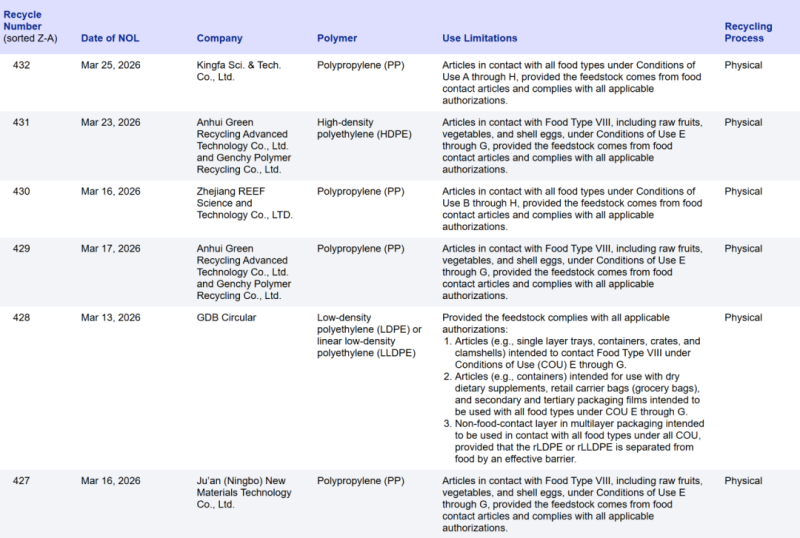
With the advancement of global plastic reduction policies and the fulfillment of brands' commitments to sustainable packaging, food-grade recycled plastics (r-Plastics) are becoming the core sector of the circular economy. In March 2026, the US Food and Drug Administration (FDA) released the latest batch of non-opposition letters (NOL) regarding recycling processes. All six of the approved processes this time were concentrated in the polyolefin (Polyolefins) field.
1.Polyolefin trend continues: Deep penetration from HDPE to PP
Following the issuance of three NOLs by the FDA in February, all of which pertained to high-density polyethylene (HDPE) recycling technology, the review results in March further confirmed that the polyolefin recycling process is now the focus of the FDA's approval.
Among the approved list this time, the physical recycling process of polypropylene (PP) performed exceptionally well. Leading enterprises Kingfa and Lifu were both listed again. Both of their applications were related to the extension of PP recycling processes. This indicates that mature recycling processes are continuously improving through technological iterations, thereby expanding their applicability in end-use food packaging.
2.Chinese enterprises "return with strength": Their technological capabilities gain international recognition
In sharp contrast to the situation in February when no Chinese enterprises received NOLs, March turned out to be a "bountiful month" for Chinese enterprises.
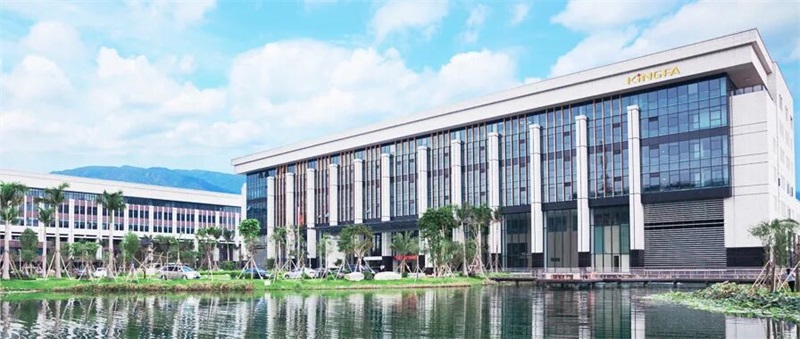
◎Kingfa Technology: The obtained PP physical recycling NOL covers all application conditions from A to H. This means that this recycled material can come into contact with all types of food, from high-temperature heat sterilization to refrigerated storage, and demonstrates extremely high safety, greatly unlocking the potential of r-PP in the high-end food packaging market.
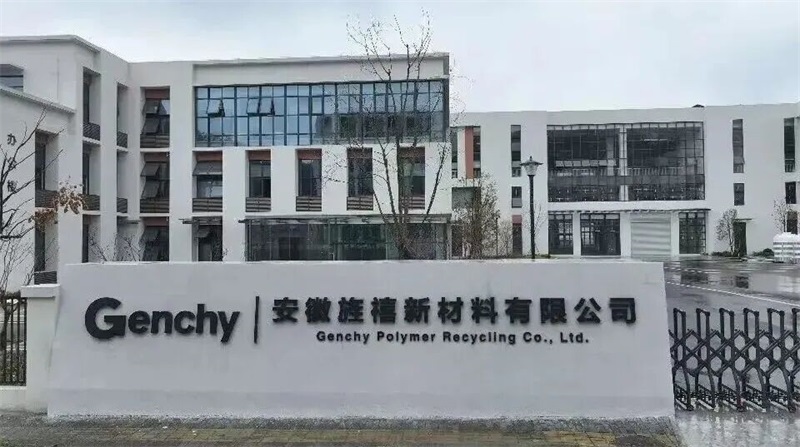
◎ Anhui Jingxi New Materials: This time, it was nominated for two NOLs in the "double list" category - one for HDPE physical recycling and the other for PP physical recycling. Its application conditions are set at the E-G level, mainly targeting category VIII foods (such as fresh fruits and vegetables, eggs with shells, etc.).
◎Lifu Technology: The applicable range of the obtained PP recycling NOL is within the B-H conditions, covering various application scenarios including boiling water sterilization and below.
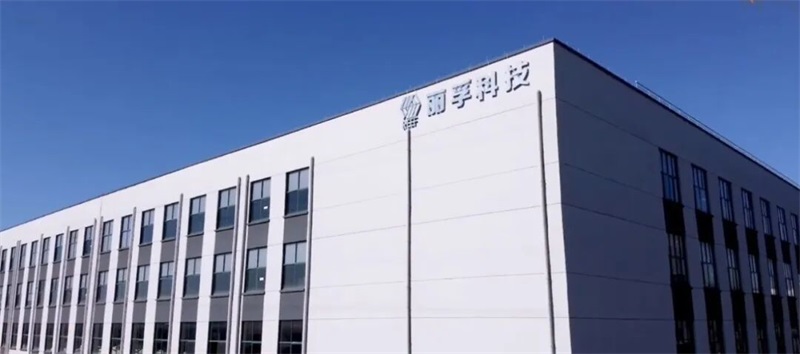
◎JUANAN (NINGBO) New Materials: Also focusing on the PP field, it has achieved NOL under E-G conditions and is targeting the huge growth market of fresh agricultural products.

3.Closing the gaps: Sporadic breakthroughs in LDPE/LLDPE and domestic shortages
Although the overall performance of polyolefins is strong, the entry barrier for low-density polyethylene (LDPE/LLDPE), which is crucial in the soft packaging sector, remains relatively high. In March, the US-based GDB Circular obtained a physical recycling NOL for LDPE/LLDPE. The application scope of this process is relatively narrow, including being used for single-layer pallets, containers (E-G conditions), and as the non-food-contact layer of composite multi-layer packaging (full conditions).
What is worth the industry's consideration is that currently, domestic enterprises in China have not received the FDA's approval letter for LDPE or LLDPE. Compared to the more rigid and easier-to-clean and purify PP and HDPE bottle pieces, the LDPE flexible packaging film, due to its larger specific surface area, easier adsorption of pollutants, and complex source, poses a higher challenge to the decontamination efficiency of the recycling process.
4.The difference in the "quality" of application conditions
For recycling enterprises, obtaining NOL is merely a prerequisite. The quantity of application conditions (Conditions of Use) directly determines the commercial value of the product.
| Application level | Technical requirements | Business application scenarios |
| A-H level (full coverage) | Extremely (requiring rigorous migration tests) | High-temperature hot filling, microwave-heated food, long-term storage packaging |
| E-G grade (room temperature / refrigerated) | Medium | Fresh produce trays, egg boxes, cold chain packaging |
Among the enterprises that have been approved this time, Jinfa Technology and Liruo Technology's focus on high-temperature grade (A and B) applications demonstrates their technological leadership in removing volatile organic compounds (VOCs) and small molecular impurities.
5.peroration
The distribution situation of FDA NOL in March indicates that the polyolefin food-grade recycling has entered an era of refined competition. The strong participation of Chinese enterprises not only proves the significant progress made by domestic physical recycling processes in terms of equipment automation and cleaning purification technologies, but also reflects the initiative of domestic recycling resource enterprises to go global and benchmark international regulations. However, in the face of technical blind spots in the recycling of soft plastics such as LDPE, domestic enterprises still need to increase their research and development investment to achieve the full coverage of the polyolefin recycling category.